Three generations facing the Mediterranean
In 1958, José María Santos Rein opened his architecture practice in Málaga. It was not the easiest moment to do so: Spain was slowly emerging from post-war isolation, materials were scarce and commissions were just beginning to appear. What there was, however, was a horizon. Literally: the Mediterranean in the background, and a coastline that was about to change forever.
To talk about the history of the studio is to talk about the history of Málaga in the second half of the twentieth century. Not because the studio was central to all of its chapters, but because it was present in enough of them for its projects to function as an involuntary record of how this city and this coast changed across six decades.
The founding years: a Costa del Sol that was inventing itself
When José María Santos Rein began practising in Málaga, tourism on the Costa del Sol was still more of a promise than a reality. Torremolinos already had a certain reputation among European travellers looking for affordable sunshine, but Marbella was still a quiet fishing village, and the Autopista del Sol would not arrive for another twenty years. The Málaga coast was beautiful and, for the most part, untouched.
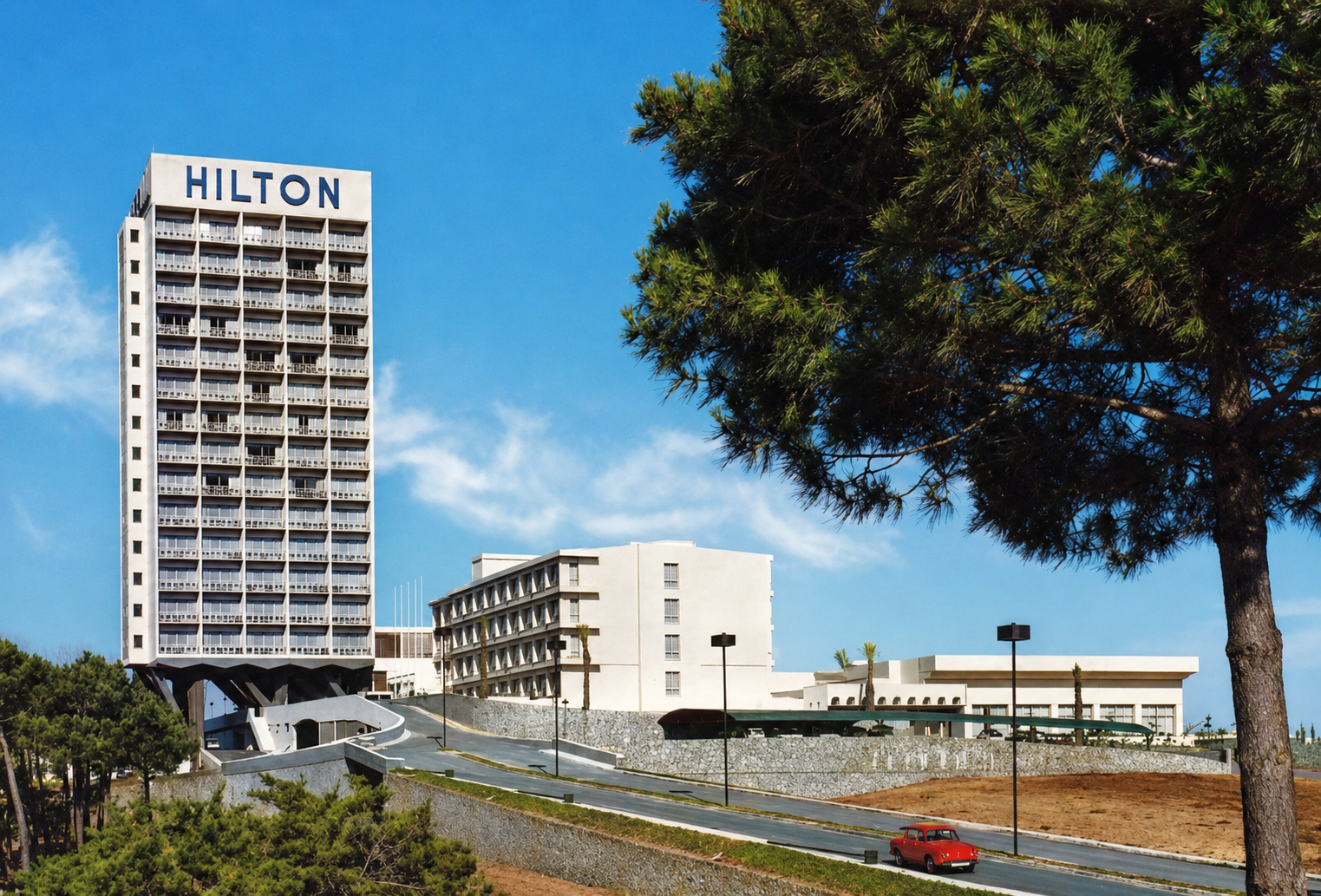
The studio's first years coincided with the first major tourism projects in the area: hotels that had to invent their own typology because there were no precedents in Spain, housing developments that had to be resolved without barely any infrastructure, homes for a local middle class that was beginning to prosper thanks to the new economic dynamism. It was a context of enormous building energy, with all the problems that energy brings when institutions and regulations are not prepared to manage it.
What distinguished the best architects of that generation was a capacity for rigorous improvisation: solving problems that had no established solution, adapting the available materials — often limited — to the demands of the brief, and keeping a cool head in the face of clients and developers who wanted results in impossible timescales. José María Santos Rein was trained in that context, and that context left a permanent mark on his understanding of the profession: pragmatic, without grandiloquence, always oriented towards making things work.
"My grandfather used to say that a building that doesn't work cannot be good architecture, no matter how beautiful it looks. That idea is still at the heart of everything we do."
The boom years: building quickly and with rigour
The 1960s and 1970s were years of great transformation. Mass tourism arrived on the Costa del Sol at a speed that exceeded all forecasts. In less than two decades, the coastal landscape changed radically: apartment blocks where there had been market gardens, hotels where there had been farmhouses, seafront promenades where there had been free beach. The demand for architects was enormous, and the temptation to build badly and quickly was too.
The studio grew during those years. José María Santos Rein brought in collaborators, expanded the types of commission he accepted — beyond the single-family house, towards large residential complexes, hotel facilities and mixed-use buildings — and began defining a way of working that prioritised construction quality over formal spectacle. It was not that he renounced aesthetic rigour; it was that he understood it as a consequence of technical rigour, not as an independent objective.
Some of the projects from that period are today, fifty years later, buildings that have aged well. Not because they were fashionable — fashion in architecture does not last long — but because they were well built, well oriented and well resolved in their relationship with their surroundings. That is the only test that matters in the long run.
The handover: continuity and renewal
The generational transition in family architecture practices is always delicate. The risk of becoming fossilised — continuing to do exactly what was done before because that is what "the studio knows how to do" — coexists with the opposite risk: breaking unnecessarily with the past, losing accumulated knowledge in the name of a renewal that does not always add value.
At the Santos studio, that transition took place gradually throughout the 1980s and 1990s. The second generation brought more systematic training in the languages of contemporary international architecture — Spanish architecture of that period was experiencing a moment of enormous openness and renewal — without abandoning the knowledge of the territory, local materials and constructive specificities of the Costa del Sol that the studio had accumulated over decades. The result was an architecture that was more explicitly contemporary in its language, but equally rigorous in its substance.
Today: the heritage as a starting point
When the third generation joins a studio with more than sixty years of history, the question is not how to differentiate from the past but how to make the most of it. There is accumulated knowledge in the studio that is not in any book: how materials behave under the sun and salt of the Costa del Sol, what mistakes were made in certain projects and why, which solutions worked and which seemed good on paper but failed on site.
That knowledge — transmitted in conversations, in reviewing the studio's archives, in visiting old buildings to see how they have aged — is perhaps the most valuable asset the studio has today. In a market in which practices are born and disappear quickly, sixty-five years of continuous presence in the same territory represents a form of expertise that is very hard to build any other way.
At the same time, the heritage cannot become a constraint. The world in which we build today — with the demands of sustainability, with digital design and management tools, with an international market that brings references and expectations from all over the world — is radically different from that of 1958. Intellectual honesty requires recognising what has changed and adapting to it, without pretending that the experience of the past answers all the questions of the present.
What José María Santos Rein started, looking out towards the Mediterranean from Málaga in 1958, remains in essence the same: a commitment to architecture that serves people, that respects the place where it is built, and that is made to last. The horizon has not changed. We have not moved away from it either.